跳到主要内容

Kmesh V1.2.0 Officially Released!

· 阅读需 4 分钟

We are delighted to announce the release of Kmesh v1.2.0, a milestone achieved through the collective efforts of our global community over the past three months. Special recognition goes to the contributors from the LFX Project, whose dedication has been pivotal in driving this release forward.

Kmesh v1.2.0 represents a significant step forward in service mesh capabilities, with improved DNS handling, better ServiceEntry support, enhanced upgrade processes, and expanded feature set in dual-engine mode. These improvements make Kmesh more robust and compatible with the latest service mesh standards.

What Makes v1.2.0 Special?

Kmesh v1.2.0 strengthens its position as a high-performance, eBPF-native service mesh by introducing:

  • Intelligent DNS interception
  • Stabilized and simplified IPsec encryption
  • Complete ServiceEntry support
  • Alpha zero-downtime daemon upgrades
  • Enhanced dual-engine resilience features
  • Full Istio 1.26 adaptation

Let’s explore these innovations in detail.

1. DNS Proxy — Smarter Service Discovery

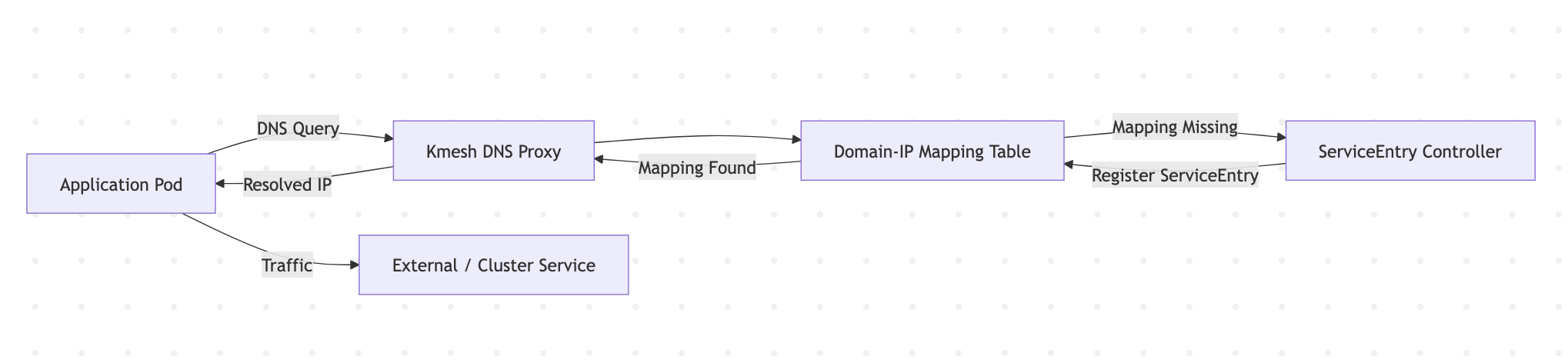
Service discovery is foundational in distributed systems. In v1.2.0, Kmesh introduces DNS Proxy capability, allowing it to intercept and manage DNS resolution requests directly.
image

Key Improvements

DNS Request Interception

  • Kmesh now captures DNS resolution requests for mesh-managed services.
  • Enables tighter control over traffic routing and service visibility.

Domain-to-IP Mapping Table

  • Dedicated internal mapping table for domain-to-address resolution.
  • Improves consistency and observability of name resolution.

Managing Non-Kubernetes Native Services • Leveraging dnsProxy, ServiceEntry can now manage external or non-native services via fake hostnames. • Expands integration flexibility across hybrid environments.

Result: Better visibility, control, and integration for modern multi-environment deployments.

2. IPsec Enhancements — Stability Meets Simplicity

Security is non-negotiable in service mesh environments. v1.2.0 delivers major improvements to Kmesh’s eBPF-based IPsec implementation.

Stability Improvements

A critical interoperability issue between Kmesh-managed and unmanaged nodes across hosts has been resolved.

What changed?

  • Redesigned eBPF decryption logic
  • Optimized xfrm state and policy configuration
  • Eliminated cross-host communication failures

image

Simplified Secret Management

kmeshctl now supports secret resource management for encryption keys:

  • Automatic key generation
  • Easier secret lifecycle management
  • Streamlined IPsec configuration

Result: Stronger encryption with smoother operations.

3. Enhanced ServiceEntry Support — Full External Integration

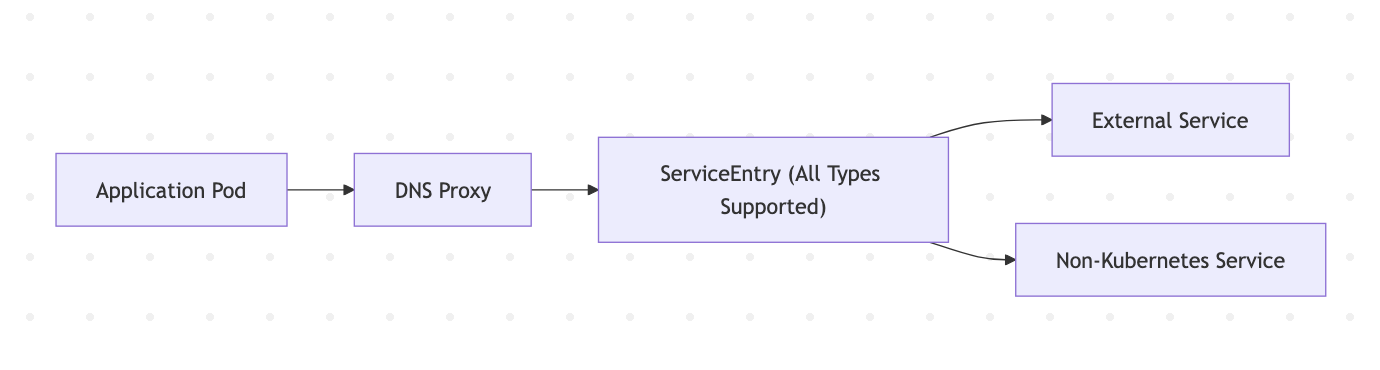
Kmesh now provides complete ServiceEntry type support, enabling seamless external service integration.

What’s New?

  • Full support for all ServiceEntry types
  • External services integration without limitations
  • DNS-based control for non-native services inside clusters

This unlocks broader hybrid-cloud and legacy integration scenarios.
image

3. Zero-Downtime Upgrade (Alpha) — Continuous Availability

Building upon earlier restart-safe architecture, Kmesh v1.2.0 introduces daemon upgrade without disrupting existing connections, as long as BPF map structures remain unchanged.

Why It Matters

  • Upgrades without traffic interruption
  • Reduced maintenance risk
  • Higher production reliability

Currently in Alpha phase, but marks a major step toward seamless lifecycle management.

image

4. Dual-Engine Mode — Resilience Under Pressure

Dual-engine mode receives powerful traffic management enhancements:

Circuit Breaking

Prevents cascading failures by stopping requests to unhealthy services.

Local Rate Limiting

Protects services from traffic spikes and overload conditions.

Together, these features provide:

  • Improved system stability
  • Better microservices fault tolerance
  • Granular traffic control

image

5. Istio Compatibility — Now with 1.26 Support

Kmesh v1.2.0 fully adapts to Istio 1.26, allowing users to benefit from the latest security and ecosystem advancements.

Deprecation Notice

  • Istio 1.23 is no longer supported in E2E testing.
  • Users are encouraged to upgrade for improved security and performance.

image

Acknowledgment

The release of Kmesh v1.2.0 is the result of an incredible global collaboration over the past three months. This milestone reflects the dedication, expertise, and open-source spirit of our growing community.

We would like to express our sincere gratitude to all contributors:

@hzxuzhonghu@LiZhenCheng9527@YaoZengzeng@Flying-Tom
@zrggw@yashisrani@AkarshSahlot@mdimado
@Vinnu124@wxnzb@072020127@xiaojiangao123

Your efforts in improving test coverage, refining eBPF logic, strengthening IPsec interoperability, enhancing kmeshctl, and maintaining documentation workflows were instrumental in shaping this release.

We are deeply grateful to everyone who contributed code, documentation, testing, ideas, and feedback. Together, we are building a powerful, sidecarless, eBPF-native service mesh for the cloud-native ecosystem.

💙 Thank you for being part of the Kmesh journey.

OSPP-2025 Automating Documentation and Release Workflows for Kmesh

· 阅读需 5 分钟
Yash Israni
Kmesh Contributor

Introduction

Hello everyone! I’m Yash Israni, an open-source enthusiast passionate about automation, DevOps practices, and building tools that eliminate repetitive manual work.

This summer, I had the privilege of participating in the Open-Source Promotion Plan (OSPP) 2025, where I collaborated with the Kmesh community to automate documentation and release workflows. Over the course of three months, I designed and implemented GitHub Actions pipelines that keep the Kmesh website always up-to-date, properly versioned, and reviewed for language quality.

In this blog, I’ll share my journey—from acceptance to project execution, the technical decisions I made, and the lessons I learned along the way.

OSPP-2025 Completing eBPF Unit Tests for Kmesh

· 阅读需 6 分钟
Wu Xi
Kmesh Contributor

Introduction

Hello everyone! I'm Wu Xi, an open source enthusiast with deep interests in kernel networking, eBPF, and test engineering.

This summer, I had the privilege to participate in Open Source Promotion Plan (OSPP) 2025 and collaborate with the Kmesh community, focusing on eBPF program UT enhancement. Over three months, I primarily completed unit testing work for Kmesh eBPF programs. I wrote and successfully ran UT test code for sendMsg and cgroup programs, and supplemented testing documentation based on this work. Kmesh community developers can now verify eBPF program logic without depending on real kernel mounting and traffic simulation, significantly improving development efficiency. In this blog, I'll share my complete experience—from acceptance to project execution, technical choices, and lessons learned along the way.

Experience of LFX Mentorship - Kmesh Tcp Long Connection Metrics

· 阅读需 3 分钟
Yash Patel
Kmesh Member

Introduction

Hello readers, I am Yash, a final Year student from India. I love building cool stuffs and solving real world problems. I’ve been working in the cloud-native space for the past three years, exploring technologies like Kubernetes, Cilium, Istio, and more.

I successfully completed my mentorship with Kmesh during the LFX 2025 Term-1 program, which was an enriching and invaluable experience. Over the past three months, I gained significant knowledge and hands-on experience while contributing to the project. In this blog, I’ve documented my mentorship journey and the work I accomplished as a mentee.

LFX Mentorship Program – Overview

The LFX Mentorship Program, run by the Linux Foundation, is designed to help students and early-career professionals gain hands-on experience in open source development by working on real-world projects under the guidance of experienced mentors

Participants contribute to high-impact projects hosted by foundations like CNCF, LF AI, LF Edge, and more. The program typically runs in 3 terms throughout the year, each lasting about three months.

More-info

My Acceptance

I am a regular opensource contributor and loves contributing to opensource. My interests heavily aligned with clound-native technologies. I was familiar with popular mentorship programs like LFX and GSoC, which are designed to help students get started in the open source world. Based on my work the Kmesh community also promoted for the member of Kmesh I had made up my mind to apply for LFX 2025 Term-1 and began exploring projects in early February. The projects under CNCF for LFX are listed in the cncf/mentoring GitHub repository. I came across the Kmesh project, a newly added CNCF sandbox project participating in LFX for the first time. I found the Kmesh project particularly exciting because of the problem it addresses—providing a sidecarless service mesh data plane. This approach can greatly benefit the community by improving performance and reducing overhead.

Kmesh came up with 4 projects in term-1, i selected long-connection-metrics projects as it allows me to works with eBPF a already have a prior experience on working with eBPF.

I began exploring the Kmesh project by reading the documentation and contributing to Good First Issues. As I became more involved, the mentors started to take notice. I also submitted a proposal for the long connection metrics project.

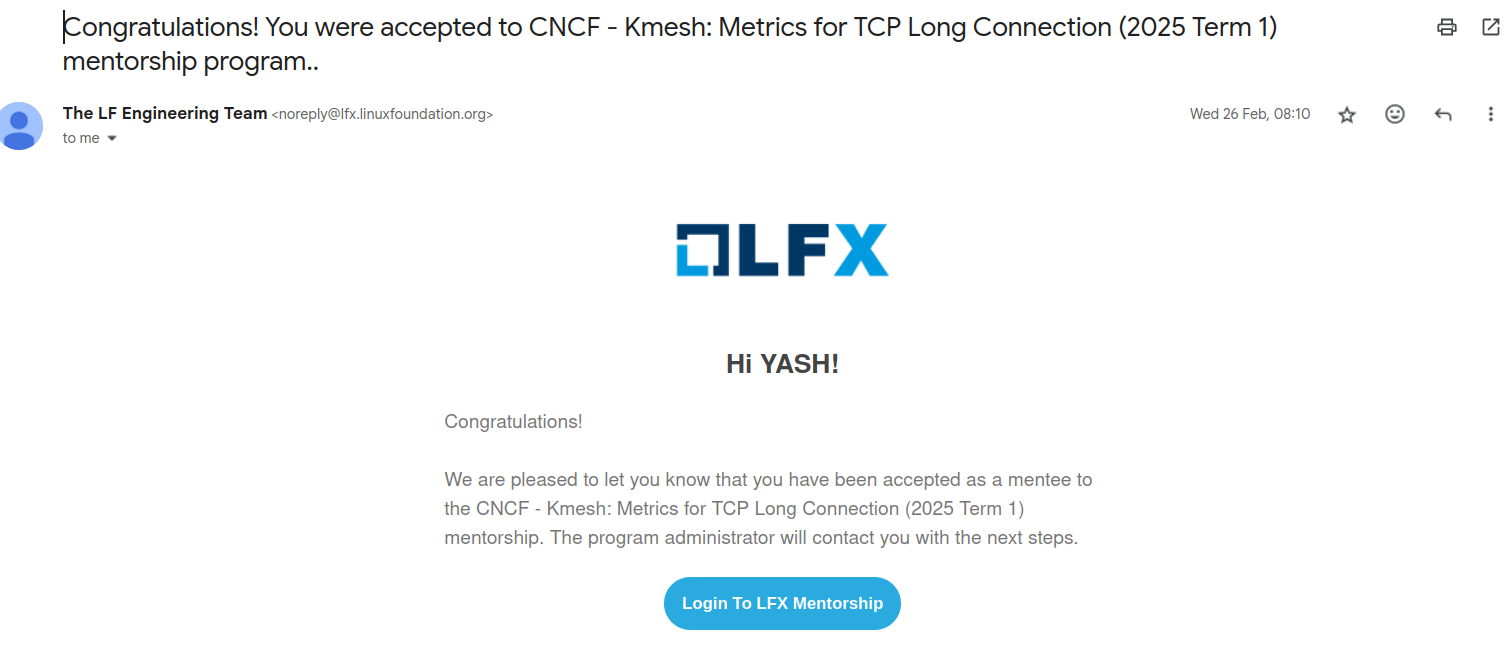
In late February, I received an email from LFX notifying me of my selection. email

Project Workthrough

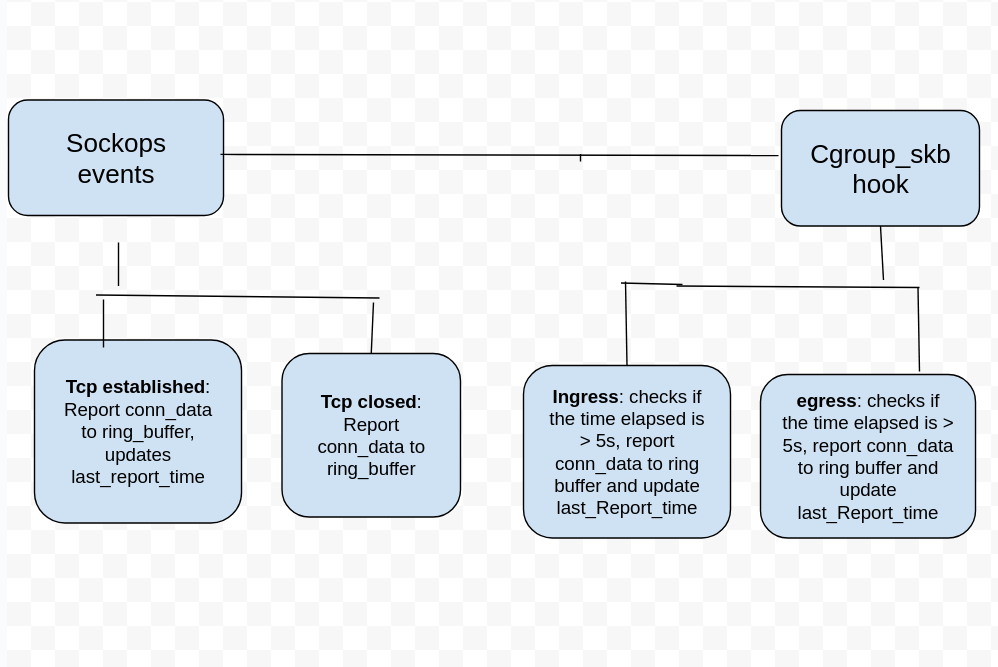
The tcp long connection metrics project aims to implement access logs and metrics for TCP long connections, developing a continuous monitoring and reporting mechanisms that captures detailed, real-time data throughout the lifetime of long-lived TCP connections.

Ebpf hooks are used to collect connection stats such as send/received bytes, packets losts, retransmissions etc.

design

More-information

Mentorship Experience

The Kmesh maintainers were always available to help me with any doubts, whether on Slack or GitHub. Additionally, there is a community meeting held regularly every Thursday, where I could ask questions and discuss various topics. I’ve learned a lot from them, including how to approach problems effectively and consider edge cases during development in these three months.

Based on my contributions and active involvement, the Kmesh community recognized my efforts and promoted me to a member of the organization. This acknowledgment was truly encouraging and motivated me to continue contributing to Kmesh and help the project grow.

Kmesh V1.1.0 Officially Released!

· 阅读需 6 分钟

We are delighted to announce the release of ​​Kmesh v1.1.0​​, a milestone achieved through the collective efforts of our global community over the past three months. Special recognition goes to the contributors from the ​​LFX Project​​, whose dedication has been pivotal in driving this release forward.

Building on the foundation of v1.0.0, this release introduces significant enhancements to Kmesh’s architecture, observability, and ecosystem integration. The official Kmesh website has undergone a comprehensive redesign, offering an intuitive interface and streamlined documentation to empower both users and developers. Under the hood, we’ve refactored the DNS module and added metrics for long connections, providing deeper insights into more traffic patterns.

In Kernel-Native mode, we’ve reduced invasive kernel modifications. Also, we use global variables to replace the BPF config map to simplify the underlying complexity. Compatibility with ​​Istio 1.25​​ has been rigorously validated, ensuring seamless interoperability with the latest Istio version. Notably, the persistent TestKmeshRestart E2E test case flaky—a long-standing issue—has been resolved through long-term investigation and reconstruction of the underlying BPF program, marking a leap forward in runtime reliability.

Main Features

Website overhaul

The Kmesh official website has undergone a complete redesign, offering an intuitive user experience with improved documentation, reorganized content hierarchy and streamlined navigation. In addressing feedback from the previous iteration, we focused on key areas where user experience could be enhanced. The original interface presented some usability challenges that occasionally led to navigation difficulties. Our blog module in particular required attention, as its content organization and visual hierarchy impacted content discoverability and readability. From an engineering perspective, we recognized opportunities to improve the code structure through better component organization and more systematic styling approaches, as the existing implementation had grown complex to maintain over time.

To address these problems, we shifted to React with Docusaurus, a modern documentation framework that's much more developer-friendly. This allowed us to create modular components, eliminating redundant code through reusability. Docusaurus provides built-in navigation systems specifically designed for documentation and blogs, plus version-controlled documentation features. We've implemented multilingual support with both English and Chinese documentation, added advanced search functionality, and completely reorganized the content structure. The result is a dramatically improved experience that makes the Kmesh site more accessible and valuable for all users.

Long connection metrics

Before this release, Kmesh provides access logs during termination and establishment of a TCP connection with more detailed information about the connection, such as bytes sent, received, packet lost, rtt and retransmits. Kmesh also provides workload and service specific metrics such as bytes sent and received, lost packets, minimum rtt, total connection opened and closed by a pod. These metrics are only updated after a connection is closed.

In this release, we implement access logs and metrics for TCP long connections, developing a continuous monitoring and reporting mechanism that captures detailed, real-time data throughout the lifetime of long-lived TCP connections. Access logs are reported periodically with information such as reporting time, connection establishment time, bytes sent, received, packet loss, rtt, retransmits and state. Metrics such as bytes sent and received, packet loss, retransmits are also reported periodically for long connections.

DNS refactor

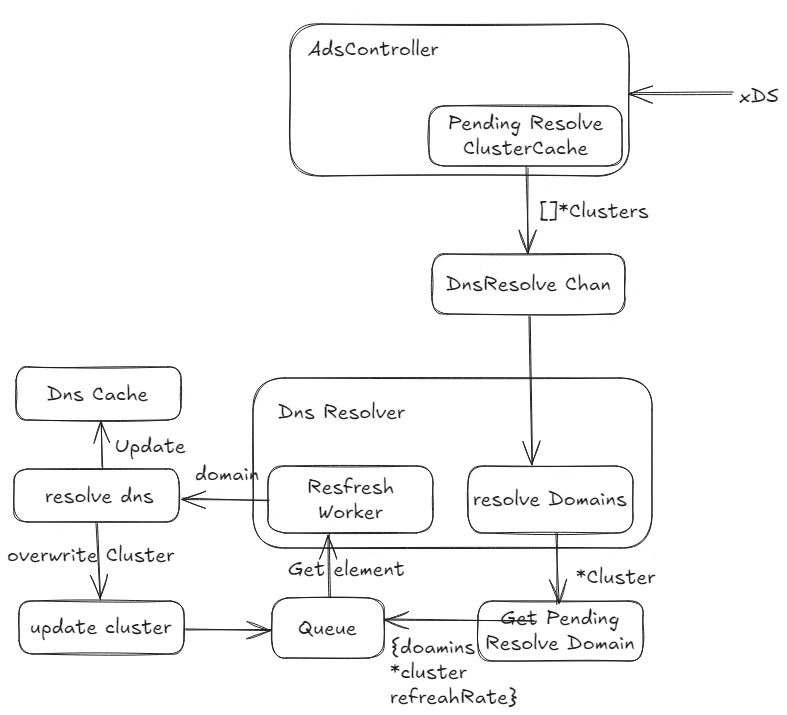
The current DNS process includes the CDS refresh process. As a result, DNS is deeply coupled with kernel-native mode and cannot be used in dual-engine mode.

image

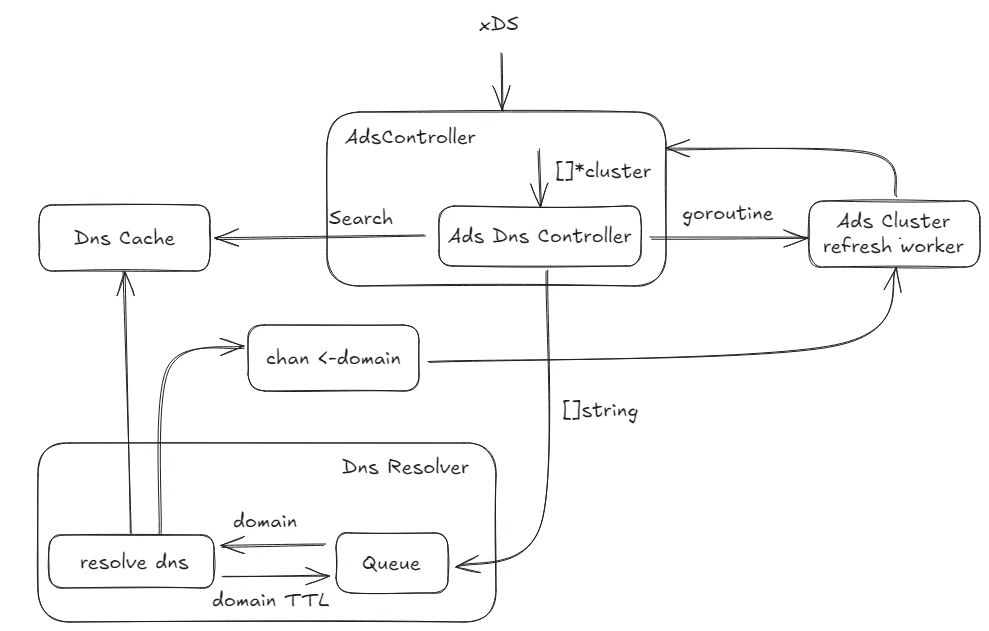
In release 1.1 we refactored the DNS module of Kmesh. Instead of a structure containing cds, the data looped through the refresh queue in the Dns is now a domain, so that the Dns module no longer cares about the Kmesh mode, only providing the hostname to be resolved.

image

BPF config map optimization

Kmesh has eliminated the dedicated kmesh_config_map BPF map, which previously stored global runtime configurations such as BPF logging level and monitoring toggle. These settings are now managed through global variables. Leveraging global variables simplifies BPF configuration management, enhancing runtime efficiency and maintainability.

Optimise Kernel Native mode to reduce intrusive modifications to the kernel The kernel-native mode requires a large number of intrusive kernel reconstructions to implement HTTP-based traffic control. Some of these modifications may have a significant impact on the kernel, which makes the kernel-native mode difficult to deploy and use in a real production environment. To resolve this problem, we have modified the kernel in kernel-native mode and the involved ko and eBPF synchronously. Through the optimization of this release. In kernel 5.10, the kernel modification is limited to four, and in kernel 6.6, the kernel modification is reduced to only one. This last one will be eliminated as much as possible, with the goal of eventually running kernel-native mode on native version 6.6 and above.

image

Adopt istio 1.25

Kmesh has verified compatibility with istio 1.25 and has added the corresponding E2E test to CI. The Kmesh community maintains verification of the three istio versions in CI, so the E2E test of istio 1.22 has been removed from CI.

Critical Bug Fix

kmeshctl install waypoint error (#1287)

root analysis:

Remove the extra v before the version number when building the waypoint image.

TestKmeshRestart flaky (#1192)

root analysis:

This issue is actually not related Kmesh restart, and it can also be produced in non-restart scenario.

The root case is that it's not appropriate to use sk as the key of map map_of_orig_dst, because it is reused and the value of map will be incorrectly overwritten, resulting in the metadata is not being encoded when it should be encoded in the connection sent to the waypoint, resulting the reset error in this issue.

TestServiceEntrySelectsWorkloadEntry flaky (#1352)

root analysis:

before this test case, there is a test TestServiceEntryInlinedWorkloadEntry which will generate two workload objects, for example, Kubernetes/networking.istio.io/ServiceEntry/echo-1-21618/test-se-v4/10.244.1.103 and ServiceEntry/echo-1-21618/test-se-v6/10.244.1.103.

In the current use case, WorkloadEntry will generate the workload object Kubernetes/networking.istio.io/WorkloadEntry/echo-1-21618/test-we.

If the test case runs fast enough, the removal operation of the first two workload objects will be aggregated with the creation operation of the latter object.

Kmesh will process the new object first and then remove the old resources, reference.

The IP addresses of these three objects are the same, which will eventually lead to the inability to find the IP address in the Kmesh workload cache, which will cause auth failure and connection timeout.

Acknowledgment

Kmesh v1.1.0 includes 118 commits from 14 contributors. We would like to express our sincere gratitude to all contributors:

@hzxuzhonghu@LiZhenCheng9527@YaoZengzeng@silenceper
@weli-l@sancppp@Kuromesi@yp969803
@lec-bit@ravjot07@jayesh9747@harish2773
@Dhiren-Mhatre@Murdock9803

We have always developed Kmesh with an open and neutral attitude, and continue to build a benchmark solution for the Sidecarless service mesh industry, serving thousands of industries and promoting the healthy and orderly development of service mesh. Kmesh is currently in a stage of rapid development, and we sincerely invite people with lofty ideals to join us!

使用 Kmesh 作为阿里云服务网格(ASM)无边车模式的数据平面

· 阅读需 8 分钟

概述

阿里云服务网格(ASM)支持边车模式和无边车模式。边车模式中,每个服务实例旁边运行一个代理,这种模式目前是最常选且较为稳定的解决方案。然而,这种架构会引入延迟和资源开销。为了解决边车模式中固有的延迟和资源消耗问题,近年来出现了各种无边车模式的解决方案,例如 Istio Ambient。Istio Ambient 在每个节点上部署 ztunnel 对节点上运行的 Pod 进行 L4 流量代理,并部署 waypoint 来处理 L7 流量代理。虽然无边车模式可以降低延迟和资源消耗,但其稳定性和功能完整性仍有待提高。

Kmesh:详细解析指标与访问日志

· 阅读需 8 分钟
lizhencheng
Kmesh Maintainer

引言

Kmesh 是一个内核原生、无边车(sidecarless) 的服务网格数据平面。借助 ebpf 和可编程内核,它将流量治理下沉到操作系统内核,从而减少了服务网格的资源开销和网络延迟。

内核中可以直接获取流量数据,并通过 bpf map 将数据传递到用户态。这些数据用于构建指标和访问日志。

Kmesh:内核级流量管理引擎,带来极致性能体验

· 阅读需 11 分钟

Kmesh 是一款全新的内核级流量管理引擎,通过基础软件创新帮助用户在云原生场景中构建高性能通信基础设施。用户可在服务网格环境中通过 helm 一键部署 Kmesh,与 Istiod 实现无缝连接。通过将流量管理下沉到操作系统,Kmesh 相比 Istio Sidecar 方案可降低超过 50% 的转发延迟,为应用提供极致的转发性能体验。

Kmesh:高性能服务网格数据平面

· 阅读需 11 分钟

什么是服务网格

服务网格的概念最初由开发 Linkerd 软件的公司 Buoyant 在 2016 年提出。Linkerd 的 CEO Willian Morgan 给出了服务网格的最初定义:

服务网格是专门用于处理服务间通信的一个层。它负责在构成现代云原生应用的复杂服务拓扑中可靠地传递请求。实际上,服务网格通常通过部署在应用代码旁边的一组轻量级网络代理来实现,而应用程序本身无需感知这一层。

简单来说,服务网格是一层处理服务间通信的机制。它通过部署一组轻量级网络代理,为现代云原生应用提供透明且可靠的网络通信。

服务网格的本质在于解决微服务如何高效通信的问题。通过实现负载均衡、金丝雀路由和熔断等治理规则,服务网格能够协调流量,最大化服务集群的能力。这是服务治理演进的产物。